A First Morning in a Market Town, with No Packed Schedule
Plan a first morning in a market town with a simple route, practical checks and room to notice how the centre connects to its rural edges.
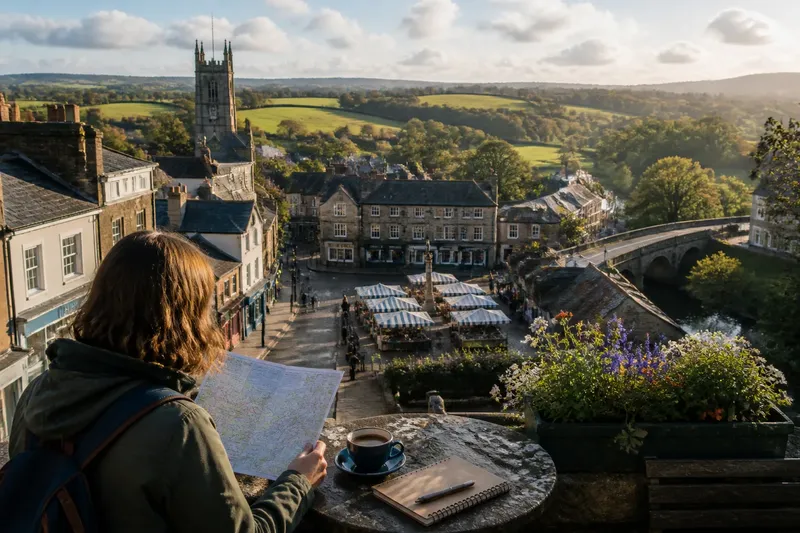
For a first morning in a market town, begin with one useful question: how does the centre connect to the places around it? Choose a modest walk that links a landmark, a practical stop and an edge of town, rather than trying to absorb every street at once. You will finish with a clearer sense of where you are and a route you can build on later.
Treat the walk like a key on a map: it helps you read the larger shape without tracing every road. A station, market square or bridge can anchor the route, but the town’s changing boundaries are the point.
How can you read the town’s shape?
Start where the centre meets a recognisable way in or out. From the railway station, walk towards the main street; from a bridge, look for the road that leads into the square. Before leaving, use a town map to identify a public place to pause and one outward route towards a river, common or fields.
As you walk, notice how the built-up centre changes. Shopfronts may give way to houses, then gardens or open ground. A church tower, a slope towards water, or a lane that narrows behind the high street can help you understand the town’s layout. These features are more useful as bearings than as items to collect.
Which route makes a useful first walk?
Choose a short line through three kinds of place: an arrival point, a centre with everyday services, and a transition towards the edge. For instance, a station-to-square walk that continues along a lane towards a footpath can show how travel, trade and countryside meet. Check the map first, then follow street signs where they are clear.
Keep the route easy to adjust. If a lane is closed or the path sign points somewhere unsuitable for your plans, return to the main street and use another public road. The purpose is to understand the connections, not to complete a particular circuit.
What can you learn from the town’s working routes?
Look for the paths people use to reach ordinary destinations: a bakery, bus stop, school gate or covered market. A delivery entrance behind the shops may explain why one lane is busy early, while a quieter parallel street may offer a direct way towards the river. These clues show how the town functions, rather than presenting it as a set of attractions.
Pause somewhere that leaves doorways and pavements clear. From a bench or café seat, notice where people cross the square and which streets carry traffic beyond it. If you are looking at a map, compare those observed routes with the lines drawn on it; the difference can help you choose a comfortable way onward.
How do you decide whether to add a detour?
Follow a detour only when it fits your time, energy and practical needs. A handwritten notice may point to a produce stall, or a lane may reveal a sign for a riverside path. Check where the turn leads and whether you can return easily, then decide whether the extra leg adds something you want to understand.
Say you arrive at a market square with a town map showing a footpath beyond the last row of houses. You note the station as your return point, walk along the main street, and find that the signed lane passes a bakery before reaching the path entrance. If the path is open and you have time, you follow it to see how quickly the town gives way to fields; if it is closed, you turn back at the sign and use the bakery lane as your route into the centre. Either way, you leave knowing where the edge begins and how to return.
Which practical checks help shape the walk?
- Check the station or bus-stop location on a town map; if it is close to the centre, start there, but if it is distant, plan a direct public-transport link or a shorter walk.
- Check the market’s posted opening information; if stalls are active, pass through the square, but if they are not, continue along the main street and return only if convenient.
- Check for a public bench, library or café on the map; if one lies near your route, keep it as a pause point, but if none does, choose a quieter public square or shorten the walk.
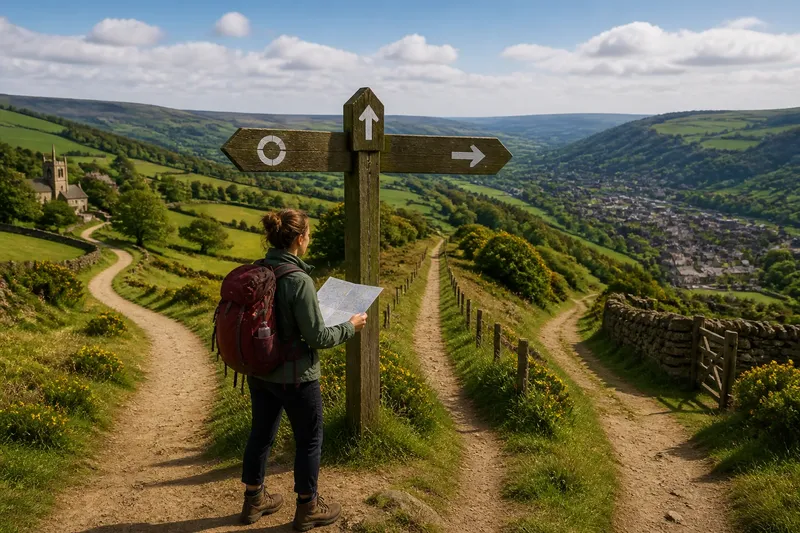
- Check whether the outward path has a clear public-access sign; if access is clear, follow it as far as suits your time, but if the sign is missing or access is restricted, stay on public streets.
- Check the return connection before leaving the centre; if the timing is suitable, keep your route open-ended, but if services are limited, set a return point and head back in good time.
- Check the forecast and look for covered public spaces along the way; if showers are likely, favour streets with arcades or a nearby hall, but if conditions turn uncomfortable, shorten the walk and return indoors.
What do visitors often ask about a first walk?
Should you begin at the market square?
Begin there if it is easy to reach and you want to see how the centre is arranged. If the square is quiet or difficult to approach, start at the station or a bridge and pass through later.
How much of the route should you choose in advance?
Mark an arrival point, a place to pause and one possible outward direction. Leave the streets between them adjustable so a closure, a useful sign or your own pace can shape the walk.
Can you follow a footpath beyond the town?
Use public signs and maps to check access, then follow the path only if the route suits your plans and conditions. If access is unclear, remain on public roads and ask locally for directions.
What if the weather changes?
Use a covered arcade, public hall or open café as a pause, then decide whether to continue. If the walk becomes uncomfortable, take the shortest familiar route back towards transport or shelter.
When is the first walk enough?
Stop when you can place the centre in relation to a few useful landmarks: the station, the market, the river or the road towards open land. You do not need to cover every lane to understand how the town connects. Note one junction or path sign that will help you set out again without starting from scratch.
A good first morning in a market town leaves you with a practical mental map: where to find the centre, how to reach its edge and which route brings you back. Keep that map in mind when choosing your next outing, and let it help you decide whether to explore a familiar street or follow a different way out.