Loop, Out-and-Back, or Point-to-Point?
Choose a loop, out-and-back, or point-to-point route by the day you want: a return to familiar ground, a measured reversal, or a journey onward.
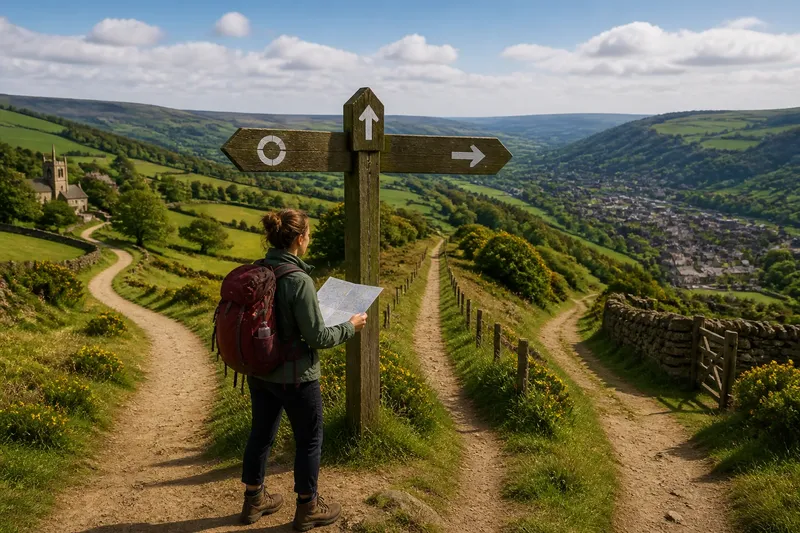
Choosing a walking route often starts with a simple question: should the path bring you back, turn you around, or carry you somewhere else? A loop, out-and-back, or point-to-point route shapes the day before you choose its lanes, villages or viewpoints. The difference is not just logistical. Each form gives the journey a distinct sense of return.
Think of the route shape as the frame around a picture: the same landscape can feel different when you enter and leave it by another edge. Use these three forms to decide what kind of day suits your energy, company and appetite for change.
1. Choose a loop when you want to return by another way
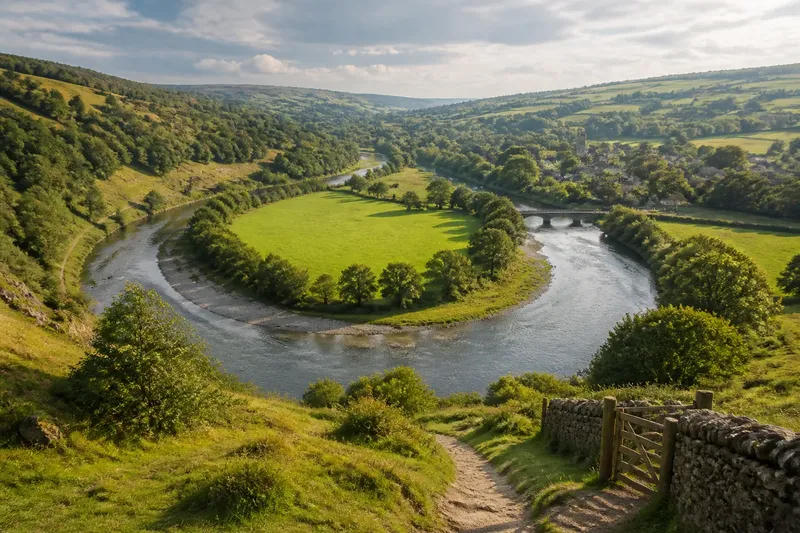
A loop begins and ends at the same place, but the outward and return legs follow different ground. That makes it a natural choice when you want the ease of leaving a car, bicycle or bag in one place without retracing the whole route. It also creates a small narrative arc: departure, distance, then a return that is familiar in destination but new in detail.
Loops often suit countryside with a network of public paths, such as a cluster of lanes and footpaths around a village. A route might leave the green by a quiet road, pass fields to a neighbouring hamlet, then return along a bridleway. The changing surfaces and boundaries can make the landscape feel less repetitive, even if the overall effort is moderate.
Look at the shape on a map rather than assuming that any line which bends back is a satisfying loop. A route may include a long stretch beside a busy road simply to close the circuit. Check whether the connecting paths are open to walkers, whether gates or crossings interrupt the route, and whether the return leg remains appealing at the time of day you expect to use it.
A loop gives you less control over the exact point at which you turn back. If the route passes a café, churchyard or stream, that place may arrive too early or too late to make a useful pause. You can still stop wherever it suits you, but the whole circuit is planned around completing the return rather than reversing at a chosen landmark.
Choose a loop when variety matters more than revisiting a particular scene, and when starting and finishing in one place makes the day simpler. It is especially fitting for a relaxed outing where the walk itself is the destination, rather than a link between two places.
2. Choose an out-and-back when you want a clear turning point
An out-and-back follows the same route in both directions. You set off from a starting place, reach a chosen point, then return along the path you already know. The repeated ground is not necessarily a drawback: a lane looks different when the sun has moved, a slope feels different under tired legs, and a familiar junction can make the return easy to read.
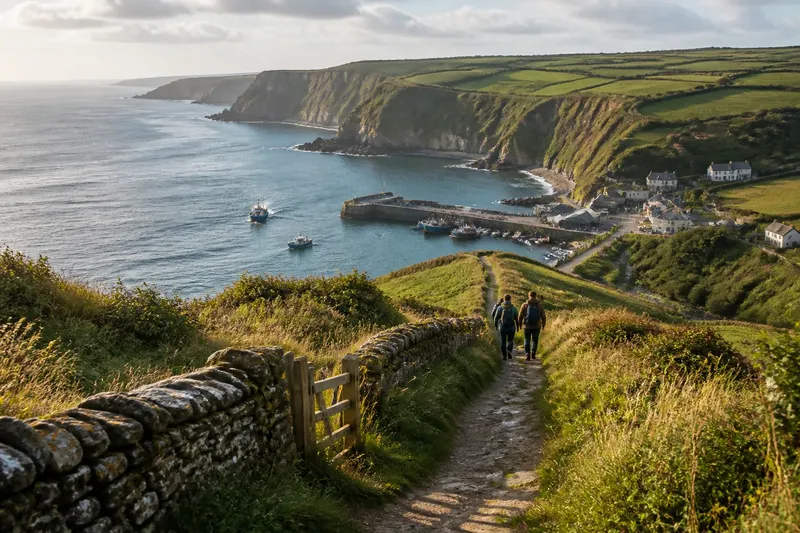
This form works well when a particular place is the reason for walking. You might follow a valley path to a bridge, a coastal track to a headland, or a farm lane to a pub before turning back. The destination gives the day a clear hinge. You can decide how far to go based on your time and energy, instead of committing to a full circuit.
That flexibility is useful, but it depends on choosing a turning point that feels satisfying and can be reached safely. A map may show a path continuing beyond a viewpoint, while the ground offers no comfortable place to pause. If the route is steep, exposed or busy, consider whether you will be content to turn around at a less dramatic spot.
Say you are planning a walk from a village to a footbridge over a stream. You have a limited afternoon and want time to stop beside the water. An out-and-back lets you make the bridge the day’s destination, pause there, and return by the same lane; if the walk takes longer than expected, you can turn back earlier without leaving a car or relying on a lift elsewhere.
Because the return repeats the route, this shape can feel calm and legible, but it may not suit someone who craves constant novelty. It is also worth noticing whether the path has safe places to step aside and whether the reverse direction changes your view of traffic or slopes. Familiarity can help with navigation, but it does not remove the need to pay attention.
Choose an out-and-back when you want a definite destination, an adjustable distance, or the pleasure of seeing the same stretch from another angle. It is often the clearest form for a short walk with one compelling turning point.
3. Choose point-to-point when the journey should lead onward
A point-to-point route begins in one place and ends in another. Instead of returning to the start, the walk carries you between destinations: perhaps from one station to the next, from a village to a neighbouring town, or from a trailhead to a place where someone can meet you. Its shape turns the route into a connector rather than a circuit.
This can give a day a strong sense of progress. The scenery and settlement may change as you move, while the ending has a practical purpose: lunch in a different village, a bus home, or an overnight stay. Point-to-point travel can make a familiar region feel more expansive because you do not need to retrace your steps to complete the outing.
The trade-off is coordination. You need to know how you will leave the finish and, if necessary, how to reach the start. Check the relevant bus or rail service, walking access at both ends, and what you will do if a connection is unavailable or a path is closed. A route that looks straightforward on a map can become awkward if the final stretch arrives after your transport has stopped running.
Point-to-point routes also ask more of your sense of direction and energy. You cannot simply turn back to the starting place once you have travelled a long way unless you are prepared to repeat the route. Consider whether the finish offers shelter, food or another way to continue, particularly if the walk crosses open countryside with few nearby services.
Choose this form when the movement between places is part of the appeal and you can make the start and finish work as a pair. It suits walkers who enjoy arriving somewhere new, and travellers who want a route to connect parts of a wider day rather than occupy the whole day by itself.
Which route shape suits your day?
Which route is easiest to shorten?
An out-and-back is often simplest to adjust because you can turn around before the planned destination and return on known ground. A loop can sometimes be shortened if there is a usable connecting path, while a point-to-point route usually needs a workable alternative to reach its finish.
Which route gives the most varied scenery?
A loop usually offers the most change in ground because its return follows a different line. A point-to-point route can also feel varied as it passes between places, while an out-and-back offers a different view of familiar surroundings rather than a wholly new route.
Which route is easiest to plan without transport?
A loop or out-and-back can start and finish at the same car park, station or village centre, so neither requires a separate ride from the endpoint. A point-to-point route can work without a car if reliable public transport links its ends, but the timetable becomes part of the plan.
Which route feels most like a journey?
Point-to-point travel most clearly carries you from one place to another, with arrival as part of the experience. A loop gives the day a sense of return, while an out-and-back centres it on reaching a chosen point and then coming home along familiar ground.
What should you check before settling on a shape?
Start with the experience you want, then test whether the route can support it. A line on a map describes direction, but not necessarily how a day will feel. Before choosing individual stops, consider:
- Start and finish: Decide whether you need to return to one base, reach a particular destination, or end near transport.
- Time and energy: Think about how much walking you want to do and whether the route has a natural point to pause or turn back.
- Path connections: Check that lanes, footpaths and bridleways connect as expected and are suitable for your intended route.
- Transport arrangements: For a point-to-point walk, plan how you will reach both ends and what your alternative is if a connection fails.
- Ground and conditions: Consider slopes, surfaces, exposure and the weather, since these can change how appealing a route feels in either direction.
- Places to stop: Notice where you can rest, find shelter or get refreshments, without assuming every village or landmark will have an open service.
- Return options: For a loop, check that the closing leg is worthwhile; for an out-and-back, identify a turning point that will still feel like a good destination.
For access rights, transport schedules and any restrictions on a particular path, check current local information and the relevant operator or land manager. Those details can shape which route form is practical, even when the map makes all three look possible.
How does each shape change the feeling of return?
The loop returns you to a known starting place by unfamiliar ground. It can make the end feel earned: you have moved through a circuit and brought the day back to its beginning. The out-and-back returns you over known ground, but the pause at the turning point divides the walk into two clear halves. The point-to-point route offers no built-in return at all; its completion is arrival elsewhere.
These differences matter because the same landscape can invite more than one kind of attention. On a loop, you may notice how fields and settlements connect around a centre. On an out-and-back, you can pay attention to what changes when you face the opposite direction. On a point-to-point route, you can follow the transition from one place to another without needing to close the circuit.
There is no universally best shape. If you want a varied walk that begins and ends at the same door, choose a loop. If a bridge, ridge or café is the reason to set out, consider an out-and-back. If you want to travel between places and can arrange the logistics, point-to-point may give the day its clearest sense of onward movement.
Before you choose stops, picture the moment the walk ends: back where you began, facing the way you came, or arriving somewhere new. That small decision is often enough to make the right route shape—and the right kind of day—plain.