The Viewpoint Trap: When a Famous Lookout Is Not the Whole Place
A famous lookout can frame a landscape beautifully. Learn to read its paths, edges and quieter surroundings for a fuller sense of the place.
A famous lookout can make a landscape seem settled: there is the view, the photograph, and the feeling that you have seen the place. But a viewpoint is only one position within a larger scene. Reading what lies beside and beyond it can turn a quick stop into a more attentive encounter with the countryside.
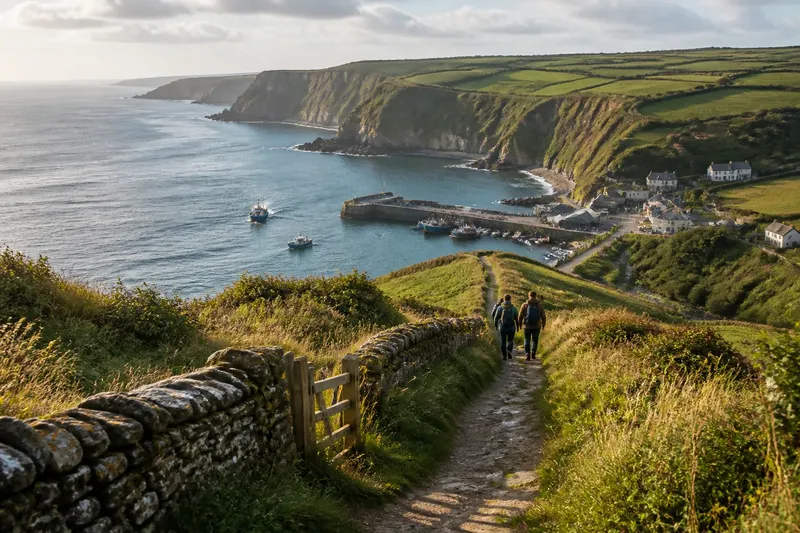
Imagine you arrive at a celebrated headland above a broad bay. The marked path leads to a stone platform, where visitors line up for the familiar sweep of cliffs and water. You take the picture, then notice that the path continues behind the platform, past a wind-bent hedge and down towards a working harbour. That invented walk offers a useful question: what does the lookout show, and what has its frame left out?
What does the famous lookout leave outside the frame?
A viewpoint is a selection. The height, direction and boundaries of the platform make some features prominent and hide others. From the headland, the bay may appear empty, even though fishing boats are moving near the harbour. The neat curve of the coast may conceal a road, a settlement or a stream entering the sea.
This is not a flaw in the view. A lookout helps the eye take in a difficult scale, much as a window frames one part of a busy room. The trap comes when the frame is mistaken for the whole room. A striking panorama can encourage the idea that the landscape is chiefly scenery, rather than a place shaped by weather, work, access and everyday movement.
In the imagined headland visit, the group’s first impression is of a remote, uninhabited coast. That impression is understandable: the platform faces away from the harbour, and the buildings sit below the cliff line. The scene has not lied; it has simply offered a partial account.
How can the surroundings change the reading?
After taking in the bay, the visitors turn from the seaward view and look at the approach. The path is worn smooth near the platform, but its edges are crowded with coarse grass. A low wall follows the slope, and a gap in it gives access to a field gate. These ordinary details suggest that the lookout sits within a network of routes and land uses, not apart from them.
They continue along the public path, keeping to its marked line. As the ground dips, the harbour comes into view: a quay, a line of sheds and boats returning towards shelter. The new angle changes the earlier impression. The bay is not simply a grand empty curve; it is also a working shoreline, linked to inland tracks and the small settlement below.
Pay attention to transitions between settings. Notice where a surfaced path becomes gravel, where a hedge opens, or where the wind drops behind a bank. These changes can tell you how people move through a place and how its terrain shapes that movement. They are often more revealing than adding another distant peak to a photograph.
What should you notice once you turn away from the panorama?
The invented group slows down without treating every detail as a clue to some hidden story. They observe what is present, distinguish it from what they are guessing, and let the view change as the path bends. That restraint matters: a wall may mark a boundary, but its exact purpose is not obvious from a glance.
- Look back along the approach. The slope and path may explain why the lookout was placed where it is.
- Notice the ground underfoot. Stone, mud, gravel and grass indicate different kinds of passage and upkeep.
- Listen for activity beyond sight. A bell, engine or bird call may direct attention towards a settlement, road or field.
- Watch the edges of the view. A track, roofline or stream near the margin can connect the panorama to its surroundings.
- Check how the scene changes with position. A short move along an open public path may reveal relationships hidden from the platform.
These observations are not a checklist for collecting details. They are prompts to look for connections: between a path and a harbour, a slope and a settlement, or an exposed ridge and the sheltered ground below. If a route is closed or the ground looks unstable, stay on an open, suitable path rather than seeking a better angle.
How can a short walk broaden the story without taking over the visit?
For the imagined visitors, the useful change is modest. They do not set out to complete a circuit or discover a secret viewpoint. They follow the marked path to the point where it overlooks the harbour, pause, and return the way they came. The panorama remains the centrepiece, but it now sits alongside the practical landscape that supports it.
That is a helpful distinction for a brief stop. The aim is not to reject the famous lookout or to insist that quieter details are inherently more authentic. A well-known view can be memorable and worth seeing. The aim is to give it company: the route in, the land immediately around the platform, and whatever activity can be observed from a respectful distance.
Travellers can also let the weather shape what they attend to. On a clear day, distant headlands may dominate. In mist, the near ground, the sound of water and the direction of the path become more legible. Neither condition gives a complete portrait; each makes different relationships easier to notice.
What questions help you read a viewpoint more fully?
Is the marked platform the only place worth stopping?
Not necessarily. A nearby public path may offer a different angle or bring smaller features into view, but the platform itself can still be the clearest and most considerate place to pause.
Does a quiet landscape mean nobody uses it?
No. People may be working, travelling or living beyond the visible frame, and activity can be seasonal or simply out of sight. Treat silence as a momentary observation, not a complete description.
How long should I spend away from the main view?
There is no required duration. A few unhurried moments looking back at the route or towards the nearest settlement can change your understanding without turning a stop into a larger excursion.
Should I leave the path to find a more dramatic angle?
Usually not. An unofficial shortcut can damage vegetation or lead onto unsafe ground, while a marked route often reveals enough to broaden the scene. Follow local signs and respect closures.
What stays with you after the lookout?
In the invented visit, the group later remembers both the sweep of the bay and the harbour tucked below it. The second detail does not replace the first; it gives it scale and human context. The headland feels less like a picture mounted on a wall and more like one part of a lived landscape.
At a famous lookout, let the first view arrive without rushing to dismiss it. Then turn around, trace the path with your eyes, and notice what changes when you move a little. A fuller sense of place often begins at the edge of the celebrated frame.
For the next famous lookout you visit, keep the question simple: what nearby feature would make this view easier to understand? That small act of attention can travel with you long after the photograph has been filed away.